 Giovannipaolo Ferrari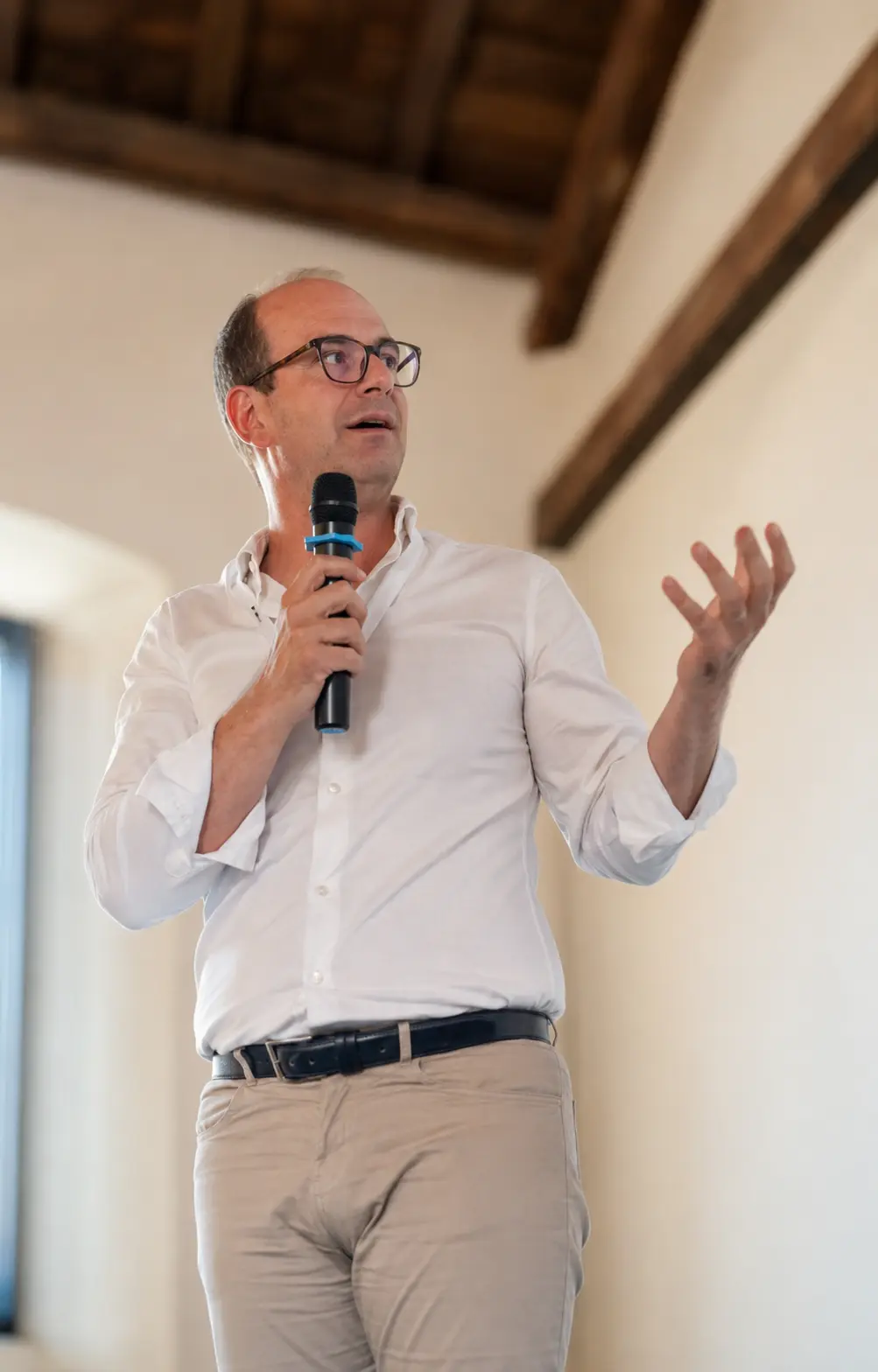
Education across disciplines and continents
Giovannipaolo Ferrari is a sociologist, researcher and lecturer at the University of Salerno’s Department of Human, Philosophical and Educational Sciences. His scientific trajectory began in the Mezzogiorno of Italy—Southern Italy—and developed between Europe and China: Rome and Salerno in Italy and Montpellier in France for his education; Lille in France for research and teaching; Dalian and Ningbo in China for an extended academic and professional experience; and Middlebury, Vermont, in the United States for research and international exchange. These places became comparative observatories for institutions, cultures and social change, informing a perspective of Global Sociology.
After studying Sociology at Sapienza University of Rome, specialising in Political Science, Public Policy Analysis and the Sociology of Administration, he further developed his work on territorial planning, sustainable development, labour and organisations.
In 2016, through an international cotutelle between the University of Salerno and Université Paul-Valéry Montpellier 3, he earned two distinct doctorates: in Salerno, a PhD in ‘Sociology, Social Analysis, Public Policy, and Theory and History of Institutions’; in Montpellier, a Doctorat in ‘Sciences du langage’, with a focus on applied linguistics. The programme received the Doctor Europaeus label and culminated in the joint thesis ‘Beyond Professions? Work in the Age of Social Media’ (2016, University of Salerno–Université Paul-Valéry Montpellier 3).
The doctoral research brought together the sociology of work, the sociology of professions and professional groups, digital discourse analysis and changing professional identities. This education across disciplines and continents still shapes his approach: qualitative and quantitative methods, policy analysis, digital methods and international comparison are combined without compromising the rigour of sociological research.
Work, digital society and methods
His early research focused on changing work, professions and communication in digital environments. Studies of web radio, social media and emerging occupations led him to examine how technologies reshape authority, competence, recognition, cooperation and membership in professional groups. This work expanded into digital corpora, CAQDAS, data visualisation and the social implications of artificial intelligence.
During the pandemic he studied metaphors, institutional data narratives and the consequences of emergency measures for education and social research. ‘Data Visualization in Shaping the Institutional COVID-19 Narrative’ (2024, Society Register) shows that data are never neutral facts, but produced, selected and narrated objects capable of shaping collective behaviour and policy decisions. The same approach informs his work on digital citizenship, civic participation and AI governance.
He founded and coordinates DiSoSWLab—Digital Society, Sport & Well-being Social Research Lab—at the University of Salerno. The laboratory connects digital society, sport, well-being and inclusion, treating empirical research, teaching and public engagement as mutually generative settings.
Sport, bodies and well-being
A second major strand concerns the sociology of sport and physical activity. Sport is analysed as a social institution, market, political language, professional environment and site of identity formation. His work addresses football and sport policy in China, transnational sporting myths, tennis and digital professions, bicycle sharing, European policy, Paralympic sport, adapted sport and disability representation. Fencing in Asia and the growth of the Asian fencing movement are included as one of several processes reshaping the geography of world sport.
A specific focus is placed on field research in adapted tennis: practices, relationships between athletes and coaches, assistive technologies and the concrete conditions of inclusion are examined together, connecting sport experience, autonomy, well-being and disability representation. The analysis therefore extends beyond events and athletes to inequalities, platforms, body cultures and mechanisms of inclusion or exclusion.
These themes run through ‘China, Sport and Society: A Sociological Perspective’ (2025, Edizioni Efesto), ‘The Digital Tennis Coach in China before and after COVID-19’ (2024, in L’atleta digitale, Editpress), ‘Tennis Coaching in China before and during COVID-19’ (2023, Contemporary Social Science) and ‘The Platformisation of Cycling’ (2024, Sustainability). His years in Dalian and Ningbo support a comparative approach to contemporary China as one of the laboratories of twenty-first-century global change.
Health, welfare and policy
Sport and health are situated within a broader sociology of well-being. In his teaching and research, Ferrari connects comparative health systems, social policy, body cultures, disability, inequality and technological change. Public policy analysis makes it possible to examine how institutions and services define needs, target groups and access criteria.
As scientific lead for ‘Digital Home Fitness and Artificial Intelligence’, he studies the opportunities and risks of physical activity mediated by platforms and intelligent systems. ‘Dis-ability!’ examines stigma through media representations of the Paralympic Games. ‘PARTECIPA. Public Sociology, Digital Citizenship and Civic Participation in the Campania Region’ connects action research, inclusion, digital citizenship and work with local communities.
Health and welfare are therefore not treated as an isolated field, but as a meeting point for empirical research, teaching and public responsibility. Data, administrative categories and technologies are studied alongside people’s experiences and the power relations organising access to resources.
Public sociology, meridian thought and territories
Public sociology connects these areas. Following Michael Burawoy, sociological research does not end with scholarly publication: it enters into relationships with different publics, creates spaces for discussion and makes visible the processes through which collective problems and decisions are formed. Ferrari brings this perspective into dialogue with Franco Cassano’s ‘meridian thought’: a public and meridian sociology capable of starting from margins, territories and Southern cultures to question the world without turning Southern Italy, the Mediterranean or the Global South into decorative frames.
This work has produced the Italian translation of Michael Burawoy’s ‘Public Sociology’ (2025, Mondadori Università), edited with Paolo Diana, and the special issue of ‘Cambio. Rivista sulle Trasformazioni Sociali’, vol. 13, no. 26 (2023), ‘The Debate on Public Social Research in Italy: History, Profiles, Perspectives’, edited by Diana and Ferrari. Together with further writings, these contributions make a central international reference available to Italian readers and examine its reception, empirical applications and digital frontiers.
Ferrari is Managing Editor of ‘Eracle. Journal of Sport and Social Sciences’, an Italian scientific journal entirely devoted to the sociology and social study of sport. He also directs the series ‘Meridies. Studies and Research in the Social Sciences’ and serves as president of Associazione Giovanni Ferrari APS, which preserves Giovanni Ferrari’s archive and cultural legacy and promotes publishing, education, scientific and cultural outreach, the Meridies Prize and public initiatives.
The convergence of university research, social engagement, interest in the cultural dimensions of society and work in local communities led Ferrari to conceive and found ‘Meridies—Festival of Southern Cultures’, of which he is artistic director and scientific lead. Research, books, encounters and Southern cultures are brought together within a shared space for public discussion.
Ferrari currently holds an RTD-A position in General Sociology, field GSPS-05/A, at the University of Salerno. He holds the Italian National Scientific Qualification for Associate Professor in General Sociology and the French Qualification for Maître de conférences, Section 19—Sociology and Demography. He is also an associate researcher at CeRIES—the Centre for Research ‘Individuals, Experiences, Societies’—at the University of Lille and works as an enseignant vacataire and chargé de cours within FaSEST—the Faculty of Economic, Social and Territorial Sciences—and IUT de Lille—the Lille University Institute of Technology, a constituent institute of the University of Lille—at Roubaix–Tourcoing. This sociology across worlds thus becomes a Global Sociology: comparative, empirically grounded, open to dialogue among scholarly traditions and accountable to its publics.